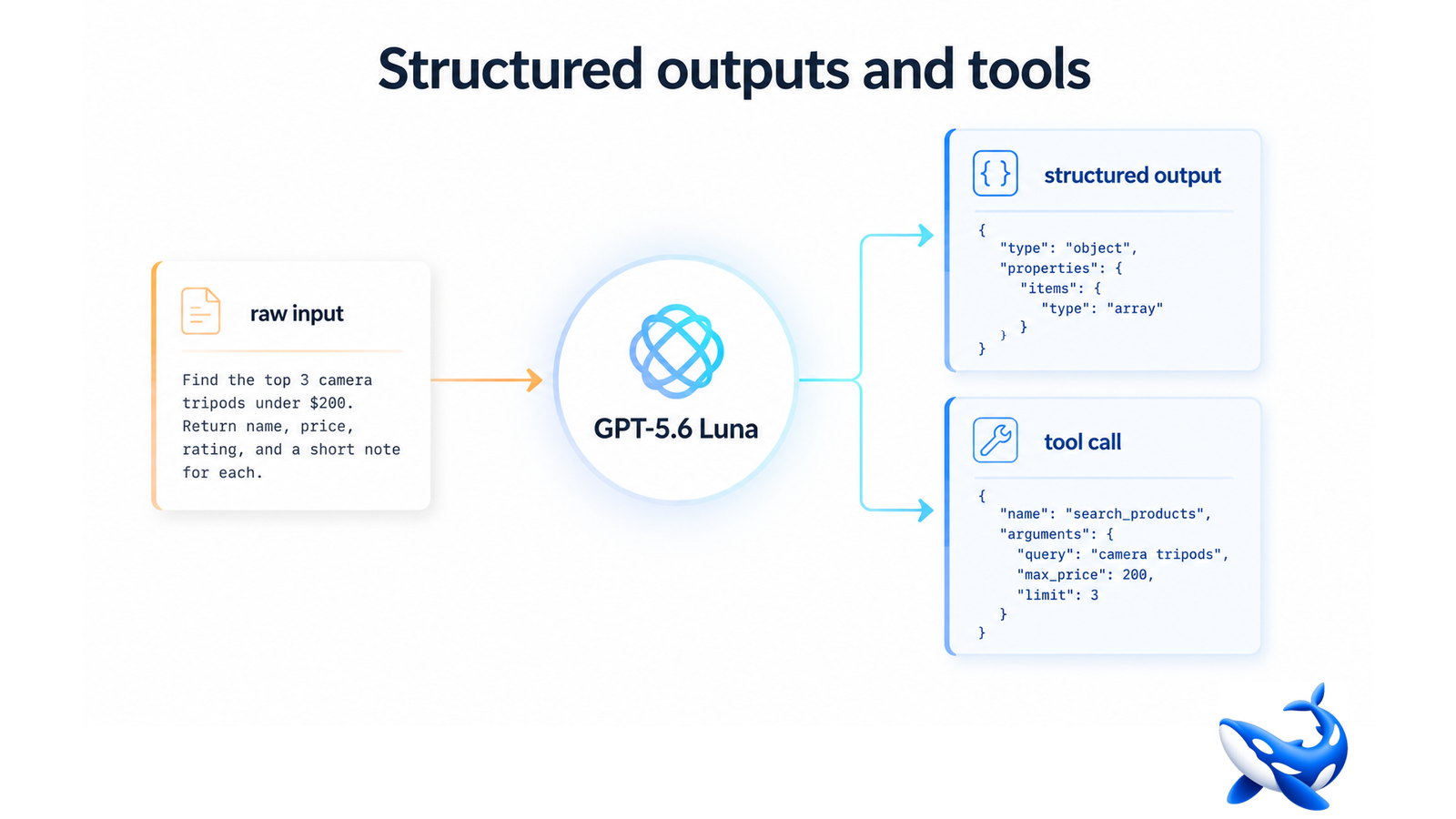
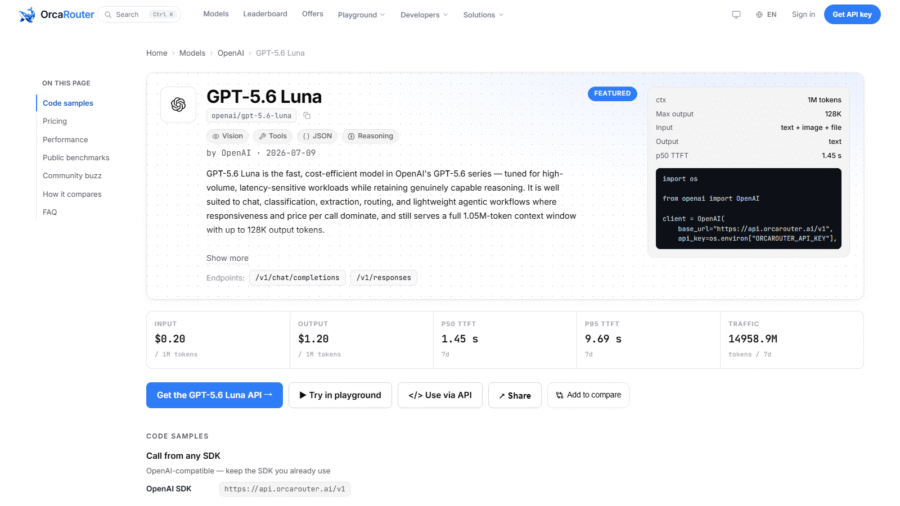
The GPT-5.6 Luna API model supports native tool calling and structured outputs, which are the two features that make a model dependable for pipelines. Combined with its price and reliability, they make Luna a strong choice for the systems that turn raw input into structured data. The GPT-5.6 family pricing breakdown covers the same model in the family context.

The difference between a demo and a pipeline is structure. A demo shows the model can answer; a pipeline needs the model to return data in a shape the code can consume, every time, without parsing prose or crossing fingers. Structured outputs and tool calling are the two mechanisms that provide that dependability.

Structured outputs: the answer comes back in a shape

Structured outputs let you specify the schema of the response, and the model returns valid data in that shape. For classification, that is a category and a confidence; for extraction, that is the fields with their values; for any downstream logic, it is data the code can consume directly. The value is that the pipeline does not have to parse prose, does not have to hope the model followed the format, and does not have to handle schema drift. The model page lists response format and structured outputs among the supported parameters, which means the dependability is native rather than bolted on.

Tool calling: the model can act

Tool calling lets the model invoke a function with the right arguments, which is what turns a model from a text generator into a component that can act. For agents, it is how a step calls an API, queries a database, or takes an action. For automation, it is how a request triggers a workflow. Luna supports native tool calling, and its 80.9 on terminal-bench 2.1 suggests the tool use is genuinely functional for lightweight agentic work. For the tasks Luna is built for — routing, lightweight agents, automation — tool calling is the mechanism that makes the model useful rather than merely responsive.

Reliability as the dependability multiplier

Structured outputs and tool calling are only dependable if the call succeeds, and Luna’s 0.05 percent error rate is what makes them dependable in production. A pipeline that extracts from a million items can rely on the vast majority of calls returning valid structured data on the first try, with a simple retry absorbing the rare failure. The combination — native structure plus a very low error rate — is what separates a dependable pipeline model from a capable one that needs babysitting.

Designing the integration

The integration pattern is standard: define the schema or tool set, send the input, get structured data or a tool call back, and validate downstream. The failure mode of structured output is not format — it is the model filling a field wrong when the input is ambiguous, so keep validation in the pipeline and let failures feed the prompt. For tool calling, verify the arguments match what your functions expect before executing them, and handle the “model wanted to call a function with odd arguments” case explicitly. These are the small disciplines that turn a capable model into a dependable pipeline component.

The cost of structure

Structured outputs and tool calls do not change the price — the model bills at $0.20 in and $1.20 out regardless. The structure is a capability, not a surcharge, which means the dependability comes at the same low price that makes high-volume pipelines affordable. That combination — native structure, low price, low error rate — is the reason Luna is the right model for the pipes that run on every item, forever.

Testing structured output before committing

Structured outputs are dependable in the shape, but the shape is not the whole story — the values matter, and the values are where testing is needed. Before committing a pipeline, test the schema on a representative sample of real inputs: the common cases, the edge cases, the inputs with missing or ambiguous fields. The goal is to find where the model fills a field wrong or returns an unexpected value, and to fix the prompt or the schema before the pipeline runs on everything. A schema that works on clean examples but breaks on the messy reality of your data is the classic failure. The testing is cheap — a few hundred requests at Luna’s price is almost nothing — and it is the difference between a dependable pipeline and one that looks dependable until the first ambiguous input. The model returns valid data; the validation ensures it returns correct data.

The takeaway

GPT-5.6 Luna’s native structured outputs and tool calling, at a 0.05 percent error rate and a $0.20/$1.20 price, make it a dependable pipeline model: classification and extraction return valid data in the shape you specify, and lightweight agents can act through tool calls. Validate downstream and verify tool arguments, and the structure is dependable at a price that makes running it at volume a rounding error.

Sourcing note: Feature support, pricing, error rate, and terminal-bench score for GPT-5.6 Luna are from the OrcaRouter model page (checked August 2026); benchmark is sourced from artificialanalysis.ai.

Has your desert cooler abruptly stopped cooling? If yes, before you call a technician for a repair, you need to evaluate its cooling pads, ventilation, pump, water tank, etc. 

One of these can be the reason the air feels warm. Even large Symphony models such as the Airforce 60 and Winter 100 XL need wet cooling pads and fresh air moving through the room. 

So, before you pay a technician for a service visit, devote a couple of minutes to these checks showcased:

Why Is My Desert Cooler Not Cooling Properly?

You switch on the cooler. The fan starts. Air comes out. Yet five minutes later, the room still feels hot. Annoying, yes. But don’t assume the motor has gone bad.

A desert air cooler has a fairly simple job. It pulls warm air through wet pads and sends cooler air into the room. When water, airflow, or ventilation is disturbed, the cooling drops. Start with the simple stuff.

1. Is There Enough Water?

Look inside the tank or check the water-level indicator. This should be your first check because an air cooler cannot cool properly with dry pads. 

If the tank is nearly empty, the fan may continue blowing as usual. The air just won’t feel much cooler.

Add clean water till it reaches the level suggested for your cooler. Never keep pouring water in after the tank is filled. Remember, more water does not always mean more cooling from the equipment.

In case you make effective use of the cooler for several hours daily, get into the habit of evaluating the tank on a regular basis. In case you experience a hot day, water can run out swiftly compared to what you expect.

2. Is the Water Pump On?

This happened in my own home once: the fan was running perfectly, but someone had switched off the pump. The cooler wasn’t broken. It was simply blowing normal air.

Certain models enable you to run the fan without switching on the cooling feature. Take a hard look at the switches or the control panel and ensure that the pump is kept on during usage. Once that is done, wait for some time. 

The water needs time to reach the pads and wet them properly. Don’t judge the cooling the moment you press the button. If cooler air starts coming out after a short while, you have found the problem.

3. Are the Cooling Pads Dirty?

Cooling pads don’t stay clean forever. Dust gets trapped in them. The side effects of hard water are white or brown deposits, too. Gradually, the surface becomes clogged, and the water does not spread through it adequately. That hurts cooling.

Before you assess the pads, unplug the cooler. If it has a dusty look, clean them as recommended in the product manual. After how long should I replace the Cooling Pads? There is no magic date. Usage matters. Water quality matters too.

If the pads have become hard, badly damaged, or remain partly dry even after cleaning, replacing them may help. A good habit is to inspect them before the summer season starts instead of waiting for the cooler to perform badly in May or June.

4. Why Are the Pads Still Dry?

A full tank doesn’t help much if water never reaches the pads. Turn the pump on and have a look. Are all the pads getting wet? If not, the water pipe may have a blockage. The pump itself could also be having trouble.

Small dirt deposits in an accessible pipe may be easy to clean, provided your product manual allows it. Don’t start opening electrical sections to investigate further. In case the pumps make no noise, do not move water, or stop repeatedly, it means that calling a technician to fix it is inevitable.

5. Does a Desert Cooler Need an Open Window?

Yes. This one makes a big difference. An air conditioner and an air cooler should not be used in exactly the same way.

With an AC, people usually shut the room. With a desert cooler for home, some ventilation is useful because fresh air needs to enter and moist air needs somewhere to go.

You do not require a strong breeze blowing in the house. A little cross-ventilation is usually enough. If you shut everything tightly, the room can become humid. At that point, sitting in front of the cooler may feel less comfortable even though the machine is running normally.

6. Where Should I Keep My Cooler?

Definitely not squeezed in the middle of the sofa and a wall. A cooler needs to pull in air before it can push cooled air out. In case the back is blocked by boxes, furniture, or a wall nearby, airflow may not happen as you want.

Try moving it near an open window or balcony door. Then check the front. Cool air should have a clear path into the room rather than hitting a cupboard two feet away.

This matters with a large model, a portable desert cooler, or a smaller room desert cooler. Sometimes the easiest fix is simply moving the unit.

7. Can Dust Make a Cooler Less Effective?

Definitely. Look at the grill after a few weeks of summer use, and you will understand why. Dust can settle anywhere air passes. A dirty grill restricts airflow. Dirty pads do the same. Don’t spray water around the motor, wiring, switches, or plug.

This isn’t about making the cooler look neat. Clear air passages help it move more air.

8. Is My Cooler Not Big Enough for the Room?

Possibly. A cooler that feels great in a bedroom may barely make a difference in a large hall.

Think about what the cooler is dealing with. A big room takes longer to cool. Strong afternoon sun adds heat. More people in the room add warmth too. So don’t choose the best desert cooler just by looking at tank capacity. Check the recommended room coverage and airflow.

A prime example of that is the Winter 100 XL by Symphony, which has been designed for larger spaces compared to several compact models. The right unit is contingent upon where you wish to utilize it.

If you plan to buy desert cooler models for a new room, measure the space first. That small step can prevent an expensive mistake.

9. Does Humidity Affect a Desert Cooler?

Yes, and quite a bit. Desert coolers usually feel strongest in hot, dry weather. Nothing may be wrong with the machine. Enhance ventilation and see whether that works for you. 

When Should I Call a Technician?

You’ve checked the water. The pads are clean. The pump is on. The cooler has enough fresh air around it. Still no luck?

Now a technician makes sense. Get professional assistance in case the pump is not working, the fan speed keeps getting lower, the motor makes an unusual sound, wires look damaged, or you observe a burning smell.

Also, take water leaking near electrical parts seriously. Don’t open the electrical section yourself just to “have a look.”

Concluding Thoughts

That depends on what’s wrong with it. Changing worn cooling pads or fixing a simple pump problem may be worth the money. But an old cooler that needs a new repair every few months can become expensive to keep.

While opting for a new cooler for home, never shop only by looking at the price. Also consider the room coverage, tank size, cooling-pad type, power usage, cleaning requirements, and airflow.

The same rule applies if you are searching for a desert cooler online. People typing desert cooler online can easily get distracted by discounts and large tank numbers.

Start with your room. A bedroom, living room, shop, and large hall won’t necessarily need the same cooler. And before you replace the existing one, go through these nine checks once. 

Keep this in mind: a forgotten pump switch, dusty pads, a closed window, or low water can make a well-oiled cooler feel like it has stopped working. 

Looking up who owns a publicly traded company is, in most cases, a solved problem. Securities regulators require public companies to disclose major shareholders, officers, and directors on a regular basis, and that information ends up in searchable filings anyone can access for free. Private companies play by an entirely different set of rules, and the difference catches a lot of people off guard the first time they need to check. There’s no equivalent disclosure requirement forcing a privately held business to tell the world who sits behind it, and depending on where that company is registered, finding out can range from a quick free search to something close to impossible without legal assistance.

This gap matters more than it might seem. Private companies make up the overwhelming majority of businesses worldwide, and they’re exactly the kind of counterparty that compliance teams, investors, and due diligence analysts most need to check, since they don’t come with the built-in disclosure that public markets require. A vendor, a supplier, an investment target, or a counterparty in a cross-border transaction is far more likely to be privately held than publicly listed, which means the hardest ownership questions tend to come up in exactly the situations where good information is hardest to find.

Understanding why private ownership data is so much harder to access, and what actually varies from country to country, makes the difference between a due diligence process that works and one that quietly has blind spots nobody notices until it’s too late.

Why Private Companies Don’t Play by Public Company Rules

Public company disclosure exists to protect investors trading shares on an open market, a rationale that simply doesn’t apply to a privately held business with no public shareholders to protect. Instead, whatever ownership information does get collected on private companies usually comes from a completely different source: anti-money laundering and beneficial ownership regulation, aimed at preventing companies from being used to hide illicit funds or evade sanctions. This distinction explains a lot about how the data behaves. Public company disclosures tend to be comprehensive, standardized, and genuinely public. Beneficial ownership data on private companies, where it exists at all, is often collected specifically for regulators and financial institutions, which means it frequently isn’t published anywhere the general public, or even other businesses, can freely search.

Wildly Different Rules from One Country to the Next

What makes this genuinely difficult is how much private company ownership data varies from one jurisdiction to the next, with no consistent global standard to rely on. A handful of countries, including the UK, Estonia, and Norway, publish beneficial ownership information for private companies openly and for free. Most countries fall somewhere in the middle, collecting the data but restricting access to regulators, obliged financial institutions, or applicants who can demonstrate a legitimate interest, often through a process that takes weeks and requires documentation in the local language. A meaningful number of countries, including the United States for domestically formed entities as of 2025, collect no centralized beneficial ownership information on private companies at all, leaving researchers to rely on indirect methods like corporate filings, court records, or direct requests to the company itself.

What You Can Usually Find, Even Without a Public UBO Register

Even in countries without open beneficial ownership data, some information is often still accessible. Directors and legal representatives are published far more consistently worldwide than beneficial owners, since most registries treat this as a basic condition of doing business. Some jurisdictions also publish shareholder information separately from beneficial ownership, which can offer partial insight even when true beneficial owners stay hidden behind nominee arrangements or corporate layers. Court filings, tax authority records, and industry-specific licensing databases can sometimes fill in gaps a general company registry leaves open. None of these substitutes are as clean as a proper beneficial ownership register, but combined, they often paint a more complete picture than assuming a closed UBO register means the trail is dead.

Building a Realistic Process Around These Limits

Teams that handle private company due diligence well tend to set expectations accordingly from the start. They document what was and wasn’t accessible in a given jurisdiction rather than treating a closed registry as a dead end that doesn’t need explaining. They separate directors, shareholders, and beneficial owners clearly in their own records, since blending the three creates false confidence about what’s actually been verified. And rather than rebuilding institutional knowledge of dozens of legal systems from scratch, many teams rely on a data provider that has already mapped which registries are open, which are restricted, and what realistic alternatives exist where the primary source is closed.

Final Thoughts

Private companies make up most of the business world, and they’re precisely the entities where ownership transparency is hardest to come by. Understanding that private ownership data plays by fundamentally different rules than public company disclosure, and that those rules shift dramatically from one country to the next, is the first step toward building a due diligence process that doesn’t quietly fall apart the moment it hits a jurisdiction without an open registry. Knowing exactly what’s accessible, and what isn’t, before a decision depends on it remains the difference between real due diligence and simply assuming the best.

Ceramic manufacturing requires more than ceramic powder and heat. Before a ceramic product can be fired, its particles must remain together during shaping, drying, handling, and transportation. A binder is added to create this temporary strength. Among the different materials available, PVA is widely valued for its water solubility, strong bonding performance, and compatibility with many ceramic processing techniques. When used correctly, it can help manufacturers produce stronger green bodies, reduce handling damage, and achieve more consistent finished components.

What Is PVA?

PVA, commonly known as polyvinyl alcohol, is a synthetic, water-soluble polymer used in numerous industrial applications. It is known for its film-forming ability, adhesive strength, and compatibility with water-based systems. These characteristics make it a practical water soluble binder for ceramics, especially when manufacturers want to avoid or reduce the use of organic solvents.

In ceramic production, PVA is generally added in small quantities to a powder, slurry, or granulated mixture. After water is removed during drying, the polymer forms flexible bridges between the ceramic particles. These bridges hold the particles together until the shaped product is fired. During firing, the binder decomposes and is removed from the ceramic body under controlled heating conditions.

Why Ceramic Materials Need a Binder

Ceramic powders such as alumina, zirconia, silica, porcelain, and technical ceramic blends may not have enough natural adhesion to maintain their shape after pressing or casting. Without an appropriate binder, a green ceramic body can crack, chip, crumble, or break while it is removed from a mould or transferred to a kiln.

A binder improves green strength, which refers to the mechanical strength of the ceramic before firing. It also supports shape retention and can make the material easier to process. The choice of binder may influence slurry viscosity, powder flow, drying behaviour, surface quality, density, and burnout performance. For this reason, selecting a suitable binder is an important part of ceramic formulation.

PVA provides the temporary bonding strength required during these early production stages. It is particularly useful when the green body must undergo machining, inspection, transportation, or additional finishing before firing.

How PVA Works in Ceramic Formulations

When PVA is dissolved in water, it forms a polymer solution. This solution can be mixed with ceramic particles to create a uniform coating around them. As the mixture dries, the water evaporates and the polymer forms a thin adhesive film. This film connects neighbouring particles and increases the strength of the green ceramic body.

The effectiveness of PVA depends on several factors, including its molecular weight, degree of hydrolysis, concentration, solution viscosity, and distribution within the ceramic mixture. The properties of the ceramic powder, including particle size and surface chemistry, also influence binder performance.

A higher concentration can provide greater green strength, but too much binder may reduce powder flow, increase drying time, or create difficulties during burnout. Ceramic producers should therefore identify an appropriate dosage through controlled laboratory and production trials.

Benefits of a Water-Soluble Ceramic Binder

One major advantage of using a water soluble binder for ceramics is the ability to prepare formulations with water instead of specialised organic solvents. Water-based processing can simplify mixing, equipment cleaning, and material handling. It may also reduce exposure to volatile organic compounds, depending on the complete formulation and production process.

PVA has excellent film-forming properties. Once dry, it creates a continuous film that helps distribute stress throughout the green body. This reduces the risk of localised damage during demoulding or handling. Its adhesive properties also allow it to work effectively with many ceramic powders.

Another benefit is formulation flexibility. Different PVA grades can provide different levels of solubility, viscosity, flexibility, and bonding strength. Manufacturers can choose a grade according to their processing temperature, required green strength, and application method.

PVA can also deliver consistent performance when the solution is properly prepared and stored. Its predictable behaviour supports repeatable ceramic production, which is especially important for precision components and high-volume manufacturing.

Common Ceramic Applications

PVA can be used in both traditional and advanced ceramics. In traditional ceramic manufacturing, it may support the production of tiles, porcelain articles, sanitaryware, decorative components, and refractory materials. Its main purpose is to improve the handling strength of the shaped material before firing.

In advanced ceramics, PVA may be used with alumina, zirconia, silicon-based materials, ferrites, and other technical powders. These materials are often used to manufacture electronic parts, wear-resistant components, cutting tools, medical products, and electrical insulators.

The polymer can be introduced into several manufacturing processes, including dry pressing, extrusion, slip casting, tape casting, and spray granulation. However, the ideal grade and concentration may differ for each process. A binder designed for pressing may not provide the same results in a casting slurry.

Preparing a PVA Solution

Correct solution preparation is essential for obtaining reliable binder performance. PVA is normally added gradually to water while the liquid is being stirred. Depending on the grade, the water may need to be heated to complete dissolution. Adding the powder too quickly can create lumps that are difficult to remove.

The manufacturer’s recommended temperature should always be followed because partially and fully hydrolysed grades may have different dissolution requirements. Excessive heating should also be avoided, as long exposure to high temperatures may affect the solution or encourage water loss.

Once the solution becomes uniform, it can be added to the ceramic mixture. Controlled mixing helps distribute the binder evenly across the particle surfaces. Air bubbles should be minimised, particularly in casting processes, because trapped air may create pores or defects in the finished product.

The solution should also be protected from contamination during storage. Changes in concentration caused by evaporation can affect viscosity and binder dosage, so containers should remain properly covered.

Selecting the Right PVA Grade

Not every PVA grade is suitable for every ceramic system. Molecular weight is one of the main selection factors because it affects solution viscosity and film strength. Higher-molecular-weight grades generally produce more viscous solutions, while lower-molecular-weight grades may be easier to mix or spray.

The degree of hydrolysis can influence water solubility, adhesion, and temperature requirements. Ceramic manufacturers should also consider the required flexibility of the green body. A brittle binder film may not perform well in a component that experiences mechanical stress before firing.

Other selection factors include ceramic powder type, particle size, processing method, drying conditions, desired green density, storage requirements, and firing schedule. Technical testing is necessary because the same PVA grade can behave differently in two ceramic formulations.

Controlling Drying and Binder Burnout

Drying must be carefully managed when PVA is used in ceramics. If water is removed too quickly, uneven shrinkage may cause cracks, warping, or internal stress. Thick or complex components may require slower drying so moisture can escape evenly from the entire body.

Binder burnout is another critical stage. The PVA must decompose and leave the ceramic body before final densification occurs. If the heating rate is too fast, decomposition gases may become trapped inside the product. This can cause bloating, pores, cracks, discolouration, or other defects.

A controlled firing schedule should provide enough time for gases to escape safely. The appropriate heating rate depends on binder concentration, component thickness, ceramic composition, furnace atmosphere, and airflow. For sensitive or high-value products, thermal analysis can help determine a suitable burnout temperature range.

Potential Challenges and Solutions

Although PVA offers many benefits, it must be formulated carefully. Excessive binder can increase viscosity, reduce ceramic solids loading, and create greater shrinkage during burnout. Insufficient binder may fail to provide the required green strength.

Poor dissolution can leave polymer particles or gel-like lumps in the mixture. These may create inconsistent bonding or surface defects. Proper water temperature, controlled addition, and sufficient mixing time can prevent this issue.

Some formulations may also become too rigid after drying. In such cases, a compatible plasticiser may be used to improve flexibility. However, every added ingredient can affect drying and firing, so the complete formulation should be tested rather than evaluating the binder alone.

Improving Ceramic Production with PVA

PVA provides a useful balance of water solubility, bonding strength, film formation, and processing flexibility. As a water soluble binder for ceramics, it can improve green strength, reduce breakage, and support cleaner water-based production. Its performance can be adjusted by selecting an appropriate grade and controlling concentration, mixing, drying, and firing conditions.

Successful use depends on more than simply adding the polymer to a ceramic powder. Manufacturers must understand how PVA interacts with their materials and equipment. With proper formulation and process control, PVA can contribute to efficient production, consistent component quality, and reliable performance across traditional and advanced ceramic applications.

Finding a streaming app that feels easy to use can be harder than it sounds. Some apps have too many menus, while others make it difficult to find the content you actually want to watch. NetMirror is one of the apps that has gained attention among people looking for a simple way to explore entertainment on different devices.
Instead of making everything feel complicated, NetMirror focuses on a straightforward viewing experience. However, because it is a third-party application, users should understand its features, device compatibility, installation process, and basic safety considerations before getting started.

What Is NetMirror?

NetMirror apk is an entertainment-focused application that provides a convenient interface for browsing and watching available video content. The exact features can vary depending on the version being used, so it is worth checking the release information before installing it.
One thing that makes the app interesting is its simple approach. Users can browse through available sections, search for titles, and select content without having to spend too much time learning how the interface works.
For many people, that matters. A streaming application should feel comfortable from the moment it is opened rather than requiring a long setup process.

Key Features of NetMirror

NetMirror comes with several features aimed at making everyday browsing easier. While features can change between releases, users may find options such as:

  • Clean and straightforward interface
  • Easy content browsing
  • Search functionality
  • Organized categories
  • Support for different screen sizes
  • Compatibility with selected Android devices
  • Playback options that may vary by available source

Regular updates in some releasesIn addition, the lightweight design of the interface can make navigation more comfortable on smaller screens. On the other hand, the experience may look different when the application is used on a television or through an emulator.

NetMirror for Android

Android users generally have the easiest installation process because APK files can be installed manually. Before doing so, however, make sure the file comes from a reliable source.
The process is fairly simple. Download the compatible APK, open the file, and follow the installation prompts. If Android asks for permission to install applications from an unknown source, the required permission can be enabled from the device settings.
Still, there is no reason to rush this step. Check the file carefully and use security software when possible. A few extra seconds of checking can save you from installing an unsafe or corrupted application.

Can You Use NetMirror on a PC?

Yes, depending on the version and its compatibility, users may be able to run NetMirror on a Windows computer through an Android emulator.
An emulator creates an Android-style environment on the PC. Once it has been installed and configured, the compatible APK can be added to the emulator.
Performance, naturally, depends on the computer. A system with enough RAM, available storage, and a reasonably capable processor should handle an emulator more comfortably. If the PC is already struggling with other applications, however, video playback may not feel as smooth.

NetMirror on Smart TV

A larger screen can make streaming much more enjoyable, particularly when watching movies or shows with family. If the particular NetMirror release supports Android TV or another compatible television platform, it may be possible to install it there.
Before installing anything, check whether the version is actually designed for TV use. A mobile APK might install but still provide a poor experience because its controls were created for touchscreens rather than remote controls.
Therefore, TV compatibility is something worth checking rather than assuming.

How to Install NetMirror Safely

The installation process depends on the device, but the basic approach remains similar. First, check that your device meets the application’s requirements. Then download the correct version from a source you trust.

After downloading, install the APK and open the application. If installation fails, check your available storage and make sure the file is compatible with your Android version.

It is also a good idea to keep your operating system updated. Moreover, avoid APK files that have been heavily modified or come from suspicious websites, especially when they request unnecessary permissions.

Common NetMirror Problems

Like many third-party applications, NetMirror may occasionally stop working properly. A weak internet connection is one of the first things worth checking if videos buffer or fail to load.
If that does not solve the problem, restart the application and clear its cache. An outdated version can also cause compatibility issues, so checking for a newer release may help.
Sometimes, however, the problem is not related to the user’s device at all. Changes on the service side can temporarily affect playback or availability. In such cases, waiting for the service or application to be updated may be the only practical option.

Final Thoughts

NetMirror can be an appealing option for users who prefer a simple interface and want to explore entertainment across compatible devices. Its usefulness largely depends on the version, device, internet connection, and available content.
Most importantly, users should treat third-party APKs carefully. Check compatibility before installation, download files responsibly, and keep your device protected. With those basic precautions in mind, you can decide whether NetMirror is a suitable addition to your entertainment setup.

Retirement is supposed to feel spacious. Calm. Earned. Yet for many affluent homeowners, the reality can be surprisingly complicated. You may be living in a beautiful high-value home, surrounded by memories, comfort, and prestige, while also wondering whether too much of your wealth is trapped in the walls around you. That tension is exactly why the jumbo reverse mortgage is drawing fresh attention among upscale retirees.

This is not just about borrowing. It is about flexibility, dignity, and the ability to shape retirement on your own terms.

For years, traditional reverse mortgages were mostly discussed in narrower financial circles, often limited by federal lending caps. But luxury homeowners have different needs. Their properties often exceed those limits, and their retirement strategies tend to be more layered. They may want liquidity without selling investments at the wrong time. They may want to age in place without sacrificing lifestyle. They may want options, not pressure. That is where reverse mortgage jumbo loans are becoming part of the conversation.

Understanding Why a jumbo reverse mortgage Feels So Relevant Now

Upscale retirees are often asset-rich but increasingly cautious about cash flow. A large home in a prime market may hold enormous value, but that value does not automatically cover healthcare costs, travel dreams, family support, home renovations, or simply the rising cost of living.

A jumbo reverse mortgage is designed for homeowners with higher-value properties who want to access more equity than a standard federally insured reverse mortgage typically allows. Instead of being boxed in by conventional limits, borrowers may unlock significantly more funds based on the value of their home, age, and lender terms.

That matters in today’s environment. Markets can swing. Interest rates can unsettle planning. Even wealthy retirees often prefer not to liquidate portfolios during a downturn. Accessing home equity can become a strategic move rather than a desperate one.

There is also an emotional layer here. Many people do not want to leave the home that holds their story. You may look around your living room and see holiday dinners, grandchildren on the staircase, late-night conversations on the patio. A move may make financial sense on paper, but life is not lived on paper.

How reverse mortgage jumbo loans Fit Into Luxury Retirement Planning

Upscale retirement planning is rarely one-dimensional. It often includes investment income, retirement accounts, taxable portfolios, real estate holdings, and estate considerations. In that setting, jumbo reverse mortgage can serve as a liquidity tool, not merely a last resort.

That distinction is important.

Some retirees use these loans to delay drawing down investment assets. Others use proceeds to pay off an existing mortgage, reducing monthly obligations and freeing up breathing room. Some improve the home so they can remain there comfortably for decades. Others create a cushion for unexpected healthcare needs or family assistance.

There is a reason this option feels newly compelling. Retirement today lasts longer. Expectations are higher. And many affluent homeowners value control above all else.

A financial advisor recently described one couple’s retirement planning meeting as almost enthralling. The word may sound dramatic for a discussion about housing wealth, yet it fit. As they explored ways to stay in their beloved coastal home without disrupting their broader portfolio strategy, the room shifted. What started as worry turned into possibility. That is the emotional power of having one more workable option on the table.

What Makes These Loans Different From Standard Options

The biggest difference comes down to property value and borrowing limits. Traditional reverse mortgages, including federally backed options, are constrained by government-set caps. Homes in luxury neighborhoods often blow past those thresholds with ease.

A jumbo reverse mortgage is offered through private lenders, which means terms, eligibility standards, fees, and available loan amounts can differ. Because these are proprietary products, they may offer larger payouts for qualified borrowers with high-value homes.

Still, bigger does not automatically mean better. You should look closely at interest structures, repayment triggers, closing costs, and the long-term effect on equity. Since the loan balance grows over time, it can reduce what is left for heirs unless the home appreciates significantly or the loan is managed strategically.

This is where thoughtful guidance matters. Upscale borrowers usually have more complexity, not less. The decision should fit into a broader estate plan, tax strategy, and retirement income framework.

The Emotional Pull of Staying Put

Money decisions are never purely mathematical, especially in retirement.

One widow in an upscale suburb described standing by her picture window at sunset, letting her gaze settle across the garden she had planted with her husband over thirty years. Her children gently suggested downsizing. Her accountant discussed efficiencies. But in that quiet moment, the truth felt clear. The home was not just an asset. It was continuity. For homeowners like her, tapping equity while remaining in place can feel deeply human, even healing.

That emotional reality is part of why interest is growing. Affluent retirees are not only evaluating rates and numbers. They are asking where they want to wake up, how they want to live, and what kind of freedom matters most.

Benefits That Often Appeal to High-Net-Worth Borrowers

Several features make these loans attractive in the luxury market:

– They can convert home equity into usable cash without requiring an immediate home sale.

– They may eliminate existing monthly mortgage payments if proceeds are used to pay off a current loan.

– They can support aging in place in a familiar and cherished environment.

– They may preserve other assets during volatile market periods.

– They can provide tailored flexibility for retirees with complex financial lives.

Of course, every advantage carries tradeoffs. The home must typically remain your primary residence. Property taxes, insurance, and maintenance responsibilities continue. And heirs will need a plan for repayment once the loan becomes due.

One retired executive jokingly said that finally unlocking the value in his multimillion-dollar home felt almost godlike, as if he had discovered a hidden lever behind the life he had built. It was a playful exaggeration, but it captured something real: the relief of realizing that wealth can serve you now, not only someday.

What You Should Consider Before Moving Forward

Before choosing this path, you should ask practical questions. How long do you plan to stay in the home? What does your estate plan prioritize? How would this affect your heirs? Are the fees justified by the liquidity you gain? Have you compared lender offerings carefully?

You should also work with specialists who understand high-value property lending. Not every advisor is well versed in proprietary reverse products. Clear modeling, family communication, and careful review are essential.

For the right borrower, this can be a smart and empowering solution. For the wrong one, it can create unnecessary cost or confusion.

Upscale retirees are paying attention because the stakes are personal. Lifestyle, legacy, comfort, and control all intersect here. When a home represents both emotional grounding and substantial untapped wealth, the appeal becomes easy to understand. These loans are gaining attention not because retirees are careless, but because they are thoughtful. They want more ways to protect the life they built and more freedom to enjoy the years ahead.

Nearly everyone who books a Sundarbans trip is secretly hoping to see a tiger. Almost nobody tells you the real odds before you pay for the tour. This article does, with the actual numbers, the genuinely best season and timing, and the things guides and operators tend to downplay simply because they’re trying to sell you a trip, not talk you out of your excitement. There’s no package being sold here, so the numbers below are unfiltered.

How Rare Is a Tiger Sighting, Really? (The Actual Numbers)

The statistics you’ll find online—and why they don’t agree

Search around, and you’ll get wildly different answers. Some operator sites quote sightings happening in less than 0.1% of visits, others say less than 1% of tours, and some independent travel guides put a multi-day trip’s odds as high as 10-20%. That’s a huge range for the same forest.

Here’s why: there’s no single official, government-tracked “sighting rate” for the Sundarbans. Every number out there, including the ones in this article, is really just an operator’s estimate, a guide’s gut feeling built from years on the water, or a travel writer’s rough guess. None of it is hard data. At Green Belt Bangladesh, we’d rather tell you this plainly upfront than let you book a trip expecting a guaranteed tiger.

The fairest way to read it: on a short, single-day trip, your real odds are low — likely under 5%. On a well-run multi-day trip into deeper zones, most experienced sources land somewhere around 10-20%. Treat any number you’re given, including this one, as a rough estimate, not a promise.

Why the odds are so much lower than somewhere like an African savanna

A few real reasons, not just bad luck:

  • The mangrove canopy blocks your viewYou’re on a boat in a waterway, not scanning open grassland, a tiger twenty meters into the trees is often just invisible.
  • You can only view from set channels and watchtowers. There’s no jeep-style off-trail tracking here; boats stick to permitted routes, so you only ever see a fraction of the forest.
  • Sundarbans tigers are unusually stealthy. They’re built for this dense, waterlogged terrain and tend to move quietly, avoiding open crossings when they can. Even close by, the thick canopy can hide them completely from your boat.

This is exactly why Green Belt Bangladesh always recommends a multi-day route into the deeper channels rather than a rushed day trip, it won’t guarantee a sighting, but it genuinely gives you a fairer shot at one.

The Best Season and Timing to Maximize Your Odds

  • Best months — November to February

Winter is the answer almost everyone agrees on. The dry season, roughly October through March, gives the clearest water and the best visibility, with December and January usually named as peak activity months. Lower water levels push animals, prey and predator alike — closer to the riverbanks, which is exactly where your boat is. If you’re planning your trip around your best shot at a sighting, this is the window to build it around.

  • Best time of day — early morning and late afternoon

This holds true across nearly every source: tigers are more active in the cooler hours, so an early morning safari genuinely improves your odds compared to a midday cruise. Late afternoon, as the heat eases off, is your second-best window, tigers tend to move closer to creek edges during both. Through the hottest part of the day, most wildlife retreats into cover, so it’s worth saving your energy and attention for dawn rather than noon.

  • Why monsoon season is much harder for sightings

June through August brings heavy rain, high water, and restricted boat access to some channels—movement patterns shift, and sightings drop noticeably. Some locals genuinely love this season for its lush green intensity and dramatic skies rather than for wildlife odds—it’s a striking time to see the mangroves, just don’t expect anything close to winter-level chances.

  • Multi-day trips vs single-day trips

This isn’t marketing spin, longer trips really do improve your odds. A single-day trip only reaches the nearby, easily accessible waterways, while a multi-day trip pushes into the deeper, quieter zones where tiger activity is genuinely higher. A rushed one-day trip from Kolkata or Mongla simply never gets far enough into the forest to reach those zones—if a sighting matters to you, this is the single biggest lever you can pull.

Where to Go — The Real Hotspot Zones

Top zones with the most reported activity

Guides and operators consistently point to the same handful of areas:

  • Sajnekhali — a major tourism hub that also houses the forest office; well-trafficked and a common entry point on the Indian side.
  • Sudhanyakhali — a popular watchtower surrounded by creeks and open clearings, often named one of the stronger zones for activity.
  • Pirkhali, Chilmari Creek, and Panchamukhani — areas known for relatively frequent activity, especially in the early morning.
  • Dobanki — known for its raised canopy walkway, giving a rare above-ground vantage point over the forest floor.
  • Chilmari Creek and Panchamukhani — noted for higher prey density and less disturbance, which in theory means more predator presence too.

Why “hotspot” doesn’t mean “guaranteed”

Read these names as “zones with the most reports,” not “zones where a sighting is likely.” Even here, timing, weather, and how the animals happen to be moving that day still decide the outcome. A hotspot just means the odds are a little better than average—not that you’re likely to see anything on any single visit.

A brief India-side vs Bangladesh-side note

Both countries have their own version of this “top zones” list, and the underlying logic is the same on either side: deeper, quieter, less-crowded channels beat the standard tourist loop. Bangladesh’s multi-day live-aboard format naturally reaches more of these deeper zones simply by staying inside the forest overnight, while India’s day-trip format is more efficient at covering the well-known hotspots near Sajnekhali and Sudhanyakhali. Whichever side you choose, it’s worth asking your operator directly whether the route goes beyond the standard loop.

What Locals and Operators Won’t Tell You?

Every operator wants you excited about seeing a tiger, that’s what sells the trip. But a few honest things rarely make it into the brochure:

  • Operators oversell your odds: not lying, just good marketing. Tiger sightings sell tours, so expect phrases like “prime tiger zone” rather than real numbers.
  • Boat rituals (Bonbibi prayers): real tradition, but they don’t actually boost safety or sighting chances. Real safety comes from licensed guides and forest rules.
  • “Guaranteed sighting” claims: a red flag. No honest wild tour can promise this; it usually means a captive/non-wild setup.
  • Bonbibi vs Dokkhin Rai legend: a beautiful piece of local culture (goddess protecting forest workers from the tiger-demon Dokkhin Rai), but it’s folklore, not a fact that affects your odds.
  • Real danger is to locals, not tourists:  honey collectors and fishermen face genuine tiger-attack risk (20-35 attacks/year in recent years). Tourists on licensed boats face almost none of that risk.

Know these going in, and you’ll enjoy the trip for what it actually is—not what the marketing promises.

How to Genuinely Improve Your Odds (Without Overpromising)?

  • Choose a multi-day trip over a single-day trip: This is the single highest-leverage decision you can make—deeper zones simply aren’t reachable on a rushed day tour.
  • Book with an operator that goes beyond the standard tourist loop: Ask directly whether the route includes lesser-trafficked zones, not just the well-known named hotspots everyone else visits.
  • Stay quiet, prioritize early morning slots, and use binoculars actively: Scan the banks and channel edges continuously rather than waiting for a guide to spot something first, a slow, deliberate scan of the treeline is a better use of your attention than watching the water.
  • Set the right personal goal:  A confirmed pugmark, a guide-verified recent sign, or a distant swimming silhouette across a creek is a genuine, worthwhile encounter with a wild Sundarbans tiger—recalibrate what counts as “success” before you go, and the trip won’t feel like a letdown if a clean sighting doesn’t happen.

If you’d like help building a multi-day itinerary aimed at the deeper, less-trafficked zones covered above, take a look at our Sundarban Tour Package or get in touch, and we’ll put one together for you.

What You’ll See Even Without a Tiger?

The tiger is the headline, but it’s genuinely not the only reason this forest is worth the trip. Expect reliable, regular sightings of spotted deer along the riverbanks, saltwater crocodiles basking on mudflats, wild boar, and, if you’re on the water at the right moment, otters and river dolphins. Birdlife is a highlight in its own right: kingfishers, birds of prey, and a strong cast of migratory species in winter draw as many dedicated birders to the Sundarbans as tiger-hunters. And the mangrove ecosystem itself—the tidal channels rising and falling by several feet a day, the extraordinary aerial root systems the trees use to breathe in waterlogged soil; and, in season, the culture of the honey collectors who still enter the forest under Bonbibi’s protection—is a genuine spectacle whether or not a tiger ever crosses your path.

Frequently Asked Questions

What are the real chances of seeing a tiger in the Sundarbans? 

Estimates vary widely depending on the source, from under 1% on a short trip to roughly 10-20% on a well-run multi-day trip into deeper zones. There’s no single official statistic—treat every number, including these, as an informed estimate rather than a guarantee.

What is the best month to see a Royal Bengal Tiger in the Sundarbans? 

December and January, within the broader November-to-February dry season, are most commonly cited as the strongest window for both weather and animal activity near riverbanks.

Has anyone actually seen a tiger on a Sundarbans tour? 

Yes, sightings do happen, including clean, close encounters, but they remain uncommon enough that most visitors who take multiple trips still haven’t had one. Indirect signs (pugmarks, guide-confirmed recent activity) are a far more common outcome than a direct visual.

Are tiger attacks on tourists common? 

No. Recorded attacks are concentrated almost entirely among honey collectors, woodcutters, and fishermen who work deep in the forest without a guide or permit—not tourists on licensed, guided boats, who operate under far more protective conditions.

Is it worth visiting the Sundarbans if you might not see a tiger? 

Yes, if you go for the ecosystem rather than a guaranteed checklist item. Birdlife, other wildlife, the tidal mangrove landscape itself, and the region’s culture are all worthwhile independent of whether a tiger appears.

Which zone has the highest chance of a tiger sighting? 

Sudhanyakhali, Sajnekhali, Pirkhali, Chilmari Creek, Panchamukhani, and Netidhopani are the zones most consistently named as having higher reported activity — though “higher” here means relative to other zones, not a meaningful likelihood in absolute terms.

Final Thoughts

The honest odds are genuinely low, and no article, including this one, or no operator can promise you otherwise. What “locals won’t tell you,” if there’s one line to take from this piece, isn’t a secret sighting hack; it’s that the tiger has never really been the whole point for the people who actually live alongside it. For centuries, the forest’s own folklore has treated the tiger as something to be respected and negotiated with, not chased down and photographed, and the trip is worth taking on those terms, sighting or no sighting.

The small appliance business has never been more competitive. Walk through a retail store or browse an online marketplace, and you’ll find hundreds of products competing for the same customer. An electric kettle is no longer just an electric kettle, and a blender is no longer judged only by its motor power. Buyers compare designs, features, durability, and even the reputation of the brand behind the product.

That shift has changed the way distributors do business as well.

For a Small Appliance Distributor, choosing the right supplier is no longer simply about finding competitive prices. Retailers expect reliable supply, a broader product selection, and brands that continue to introduce products customers actually want to buy. Working with a supplier that grows with the market helps distributors stay competitive without constantly changing suppliers.

SOKANY has spent more than 30 years building exactly that kind of business. The company’s product range, manufacturing capacity, and global dealer network have been steadily growing since its inception. Today, SOKANY provides small appliances to customers in more than 150 countries.

These business development trends can make it easier for distributors looking to choose the right supplier as they expand in the appliance industry.

Why Brand Development Matters More Than Price

Ask experienced distributors what makes a supplier valuable, and price is rarely the first answer.

Competitive pricing certainly helps, but it doesn’t solve inventory shortages, inconsistent quality, or outdated product lines.

Today’s retailers are also more selective than they were a few years ago. Many prefer working with distributors that represent established brands because it gives shoppers greater confidence in the products they’re buying.

That means distributors now evaluate suppliers from a much broader perspective.

They tend to seek out brands that can provide:

  • A wide variety of products rather than just a few popular items
  • Consistent manufacturing quality across every product category
  • Regular product launches that help retailers stay competitive
  • Sustainable manufacturing and marketing practices
  • Long-term business partnerships rather than one-time transactions

These strengths are not built overnight. They are typically investments that can have taken years to develop, research, and expand the market.

How SOKANY Has Grown with Market Demand

A part of SOKANY’s ability to grow is due to the fact that it does not narrow itself to one product category.

Household needs have evolved and with it has evolved the company’s product range. With over 100 categories of appliances and more than 2,000 models available, SOKANY now provides distributors with the freedom to order a variety of everyday household products from one supplier.

It has a catalog that now contains products across categories, such as

  • Kitchen appliances
  • Home appliances
  • Beauty and personal care appliances

This makes sourcing much more efficient for distributors. They can develop an entire product portfolio with one supplier, ensuring consistent quality across product lines rather than having to deal with multiple suppliers.

The same goes for the company’s global growth. According to SOKANY’s official information, the brand now serves customers in more than 150 countries, exports millions of units per year, and has 20+ national exclusive agents in countries around the world. Those are more than growth numbers; they are operational experience to serve distributors in various markets.

SOKANY’s small appliance collection is available on their official website for businesses to browse for new product ideas. The range is constantly being expanded to meet market demand and is easy for the wholesalers and retailers to expand the range with new products without having to change the manufacturing partners.

Key Brand Development Trends Every Distributor Should Watch

The small appliance market doesn’t stand still for long. As consumer preferences, technology, and shopping habits continue to evolve, the products that are doing well this year may be facing a more difficult competition next year. This is why effective distributors are always focused on the changing nature of brands, not what they’re selling now.

SOKANY’s growth reflects several trends that are shaping the future of the industry.

Expanding Beyond Individual Products

Years ago, many retailers purchased appliances category by category. Today, they’re more interested in working with suppliers that can provide a complete product range under one trusted brand.

A retailer might begin by stocking electric kettles and blenders, then later add garment steamers, hair dryers, or cleaning appliances. When those products come from the same supplier, ordering becomes simpler and the brand presentation in-store feels more consistent.

SOKANY has followed this direction by steadily expanding its portfolio across more than 100 categories. As a distributor, you can have fewer suppliers to manage and more orders to sell to existing customers—more value per order.

Innovation That Solves Everyday Problems

Sometimes, innovation is not based on the latest technology. It’s often a matter of making everyday things more useful.

Consumers like appliances that are user-friendly, easy to clean, space-saving for today’s homes, and built to last. Here are the factors that can affect repeat customers and customer satisfaction.

Building Stronger Global Partnerships

How well a company performs in the international markets is an indicator of its operational strength.

Products can be supplied to over 150 countries with consistent production and quality control as well as consistent logistics that the distributors can rely on. It also shows familiarity with various companies with different market needs and customer expectations.

When a distributor is looking to expand and grow their business in the future, he or she may have a greater level of certainty and confidence when working with an established international brand.

What Makes SOKANY a Practical Choice for Distributors?

While each distributor’s business objectives are different, they are all looking to overcome the same challenges: reliable products, streamlined sourcing processes, and establish deeper relationships with retailers over the long-haul.

SOKANY merges those priorities, offering both a variety of products and years of manufacturing experience and dealer support.

What Distributors NeedHow SOKANY Supports Their Business
A broad product rangeMore than 100 home appliance categories and 2,000+ models
Reliable manufacturingOver 30 years of experience in the small appliance industry
Global business opportunitiesProducts supplied to customers in more than 150 countries
Efficient sourcingOne supplier for multiple household appliance categories
Business supportMarketing assistance, after-sales support, and dealer resources
Long-term growthContinuous product development and expanding international presence

The benefits for many distributors can simply be more time spent on customers and less time spent on dealing with a number of suppliers.

Final Thoughts

You don’t need to target every product as it comes out of the market to build a successful distribution business. It’s about selecting manufacturing partners who will continually enrich, advance and assist your business in the future.

That long-term approach is evident in SOKANY’s development. Throughout the years, the company has diversified its product line, bolstered its global footprint and committed resources to enable distribution partners to position themselves in the appliance environment of today. Those efforts have helped the brand gain the trust of wholesale partners throughout the world.

When your business is just starting out or you’re seeking to revamp an existing distribution structure, having a supplier who can develop knowledge of the market’s ever-shifting demands can make a significant difference. As a continuous innovator, with ongoing product diversification and strong distributor support, SOKANY is a reliable partner for businesses seeking sustainable growth in the small appliance industry.

A bad label can ruin a great product. It peels off in the rain, fades under sunlight, and bubbles on curved bottles. Customers notice these issues immediately, and trust in the product drops quickly.

Most businesses pick a generic label and hope for the best. That approach costs more in the long run. Returns go up, reprints happen, and brand image takes a hit.

Custom label materials solve these problems from the start. HARDVOGUE specializes in developing label solutions tailored to your specific product requirements. This isn’t about fancy packaging, it’s about labels that perform reliably and consistently in real-world conditions.

Why Generic Labels Keep Failing Brands

Walk into any warehouse or factory, and you’ll notice labels that are peeling, smearing, or shrinking. These aren’t printing mistakes; they’re material issues. The positive side is that with the right label materials, these problems can be easily avoided, ensuring stronger performance and lasting quality.

Generic labels are made for average conditions. Most products do not live in normal conditions. A bottle sits in a cold fridge. A drum sits in a chemical storage room. A cosmetic jar gets handled with wet hands every morning.

Each of those situations needs a different material. HARDVOGUE knows this. That is exactly why they do not sell one label type to every client.

How HARDVOGUE Builds Custom Label Solutions

It Starts With a Real Conversation

HARDVOGUE does not rely on a one-size-fits-all catalog approach. That is not how effective labeling solutions are created. That is not how good labeling works.

Before anything else, the team wants to know the product. Where does the label go? What does it face every day? Heat? Moisture? Direct sun? Chemical exposure?

These are not checklist questions. They are the foundation of every decision that follows. One product ships in cold storage. Another sits on a sunny retail shelf. A third gets handled with wet hands twice a day. Each one needs something different.

HARDVOGUE treats every client as a separate case. Same questions, different answers, different solutions every time.

You can explore how HARDVOGUE’s customized formula service works, from humidity and temperature conditions to printing machine compatibility.

Choosing the Right Base Material

Most brands never think about what their label is made of. That is where problems begin. The base material is called a substrate. HARDVOGUE offers several options based on the product’s actual exposure.

  •  Adhesive art paper is suitable for dry indoor use.
  • BOPP wrap-around label film handles moisture and works great on bottles.
  • Adhesive PET film resists heat, chemicals, and outdoor conditions.
  • Adhesive PVC film conforms to curved or uneven surfaces.
  • Adhesive metalized paper delivers a premium metallic look for luxury goods.

Wrong substrate, wrong result. HARDVOGUE helps clients get this right before production starts.

Matching the Adhesive to the Surface

HARDVOGUE offers adhesive material options based on the job:

  • Permanent adhesive for labels that must stay on for life
  • Removable adhesive for promotional or reusable packaging
  • Freezer-grade adhesive for cold storage and frozen goods
  • High-tack adhesive for rough, textured, or low-energy surfaces

Getting this right the first time saves time and money. HARDVOGUE tests adhesive compatibility before recommending an option.

Print and Finish Options That Match Your Brand

Labels have to look good. That is non-negotiable. HARDVOGUE works with different printing methods.

Digital printing on glossy BOPP gives bold, sharp colors.

Thermal transfer on polyester suits for industrial use. The text stays clean even after rough handling.

Finish matters too. Gloss catches the eye on retail shelves. Matte gives a quiet, premium feel. Textured finishes add something tactile. UV coating protects against scratches and sunlight.

None of these is a random choice. HARDVOGUE picks the finish based on where the product lives and what the brand needs to communicate.

Solutions Built for Specific Industries

Not every industry plays by the same rules. Labels that work in one sector can completely fail in another.

Food brands need labels that survive fridges and freezers. Moisture is a constant enemy. Beverage bottles sweat. Labels peel if the material is wrong.

Pharma is a different world. Print clarity is critical. Dosage information cannot smear or fade. Many products also need tamper-evident features built into the label itself.

Cosmetics sit in bathrooms. Steam, water, and daily handling wear labels down fast. The material has to hold up without looking worn.

Industrial products face the harshest conditions. Chemicals, heat, and rough surfaces all quickly break down weak labels.

HARDVOGUE knows each of these environments well. Clients bring their product. HARDVOGUE brings the right material for it.

Small Orders or Large Runs, Both Are Welcome

Many small brands struggle to find a supplier who will work with low quantities. Most suppliers push for bulk orders that small businesses cannot afford.

HARDVOGUE solves this. Short-run orders are fully supported with no compromise on quality. As businesses grow, HARDVOGUE scales production with them. The material quality and finish stay consistent whether a client orders a few hundred labels or tens of thousands.

This flexibility makes HARDVOGUE practical for startups, growing brands, and large manufacturers alike.

Why You Should Choose HARDVOGUE Custom Label Materials

HARDVOGUE brings material knowledge, industry experience, and a process built around the client’s actual needs. There is no guesswork. Every label recommendation is based on facts about the product and environment.

Their range of substrates, adhesives, and finish options makes the process easy. As there is always a right answer for each situation. Clients do not have to pick from a shortlist of average options.

Beyond the materials, HARDVOGUE offers the kind of support that prevents expensive mistakes. Getting the label right the first time saves money. More so, it protects the brand and keeps customers happy.

Labels that fail cost more than just money. They cost customer trust. HARDVOGUE helps brands get it right the first time.

Ready to Get the Right Label for Your Product?

Stop settling for labels that almost work. A bad label costs more than a reprint,  it costs customer trust. HARDVOGUE has the expertise and product range to match every product to its perfect label material. Do not wait for a failure to push you into action.

 Contact HARDVOGUE today and get a solution built specifically for your product.