

Ceramic manufacturing requires more than ceramic powder and heat. Before a ceramic product can be fired, its particles must remain together during shaping, drying, handling, and transportation. A binder is added to create this temporary strength. Among the different materials available, PVA is widely valued for its water solubility, strong bonding performance, and compatibility with many ceramic processing techniques. When used correctly, it can help manufacturers produce stronger green bodies, reduce handling damage, and achieve more consistent finished components.
What Is PVA?
PVA, commonly known as polyvinyl alcohol, is a synthetic, water-soluble polymer used in numerous industrial applications. It is known for its film-forming ability, adhesive strength, and compatibility with water-based systems. These characteristics make it a practical water soluble binder for ceramics, especially when manufacturers want to avoid or reduce the use of organic solvents.
In ceramic production, PVA is generally added in small quantities to a powder, slurry, or granulated mixture. After water is removed during drying, the polymer forms flexible bridges between the ceramic particles. These bridges hold the particles together until the shaped product is fired. During firing, the binder decomposes and is removed from the ceramic body under controlled heating conditions.
Why Ceramic Materials Need a Binder
Ceramic powders such as alumina, zirconia, silica, porcelain, and technical ceramic blends may not have enough natural adhesion to maintain their shape after pressing or casting. Without an appropriate binder, a green ceramic body can crack, chip, crumble, or break while it is removed from a mould or transferred to a kiln.
A binder improves green strength, which refers to the mechanical strength of the ceramic before firing. It also supports shape retention and can make the material easier to process. The choice of binder may influence slurry viscosity, powder flow, drying behaviour, surface quality, density, and burnout performance. For this reason, selecting a suitable binder is an important part of ceramic formulation.
PVA provides the temporary bonding strength required during these early production stages. It is particularly useful when the green body must undergo machining, inspection, transportation, or additional finishing before firing.
How PVA Works in Ceramic Formulations
When PVA is dissolved in water, it forms a polymer solution. This solution can be mixed with ceramic particles to create a uniform coating around them. As the mixture dries, the water evaporates and the polymer forms a thin adhesive film. This film connects neighbouring particles and increases the strength of the green ceramic body.
The effectiveness of PVA depends on several factors, including its molecular weight, degree of hydrolysis, concentration, solution viscosity, and distribution within the ceramic mixture. The properties of the ceramic powder, including particle size and surface chemistry, also influence binder performance.
A higher concentration can provide greater green strength, but too much binder may reduce powder flow, increase drying time, or create difficulties during burnout. Ceramic producers should therefore identify an appropriate dosage through controlled laboratory and production trials.
Benefits of a Water-Soluble Ceramic Binder
One major advantage of using a water soluble binder for ceramics is the ability to prepare formulations with water instead of specialised organic solvents. Water-based processing can simplify mixing, equipment cleaning, and material handling. It may also reduce exposure to volatile organic compounds, depending on the complete formulation and production process.
PVA has excellent film-forming properties. Once dry, it creates a continuous film that helps distribute stress throughout the green body. This reduces the risk of localised damage during demoulding or handling. Its adhesive properties also allow it to work effectively with many ceramic powders.
Another benefit is formulation flexibility. Different PVA grades can provide different levels of solubility, viscosity, flexibility, and bonding strength. Manufacturers can choose a grade according to their processing temperature, required green strength, and application method.
PVA can also deliver consistent performance when the solution is properly prepared and stored. Its predictable behaviour supports repeatable ceramic production, which is especially important for precision components and high-volume manufacturing.
Common Ceramic Applications
PVA can be used in both traditional and advanced ceramics. In traditional ceramic manufacturing, it may support the production of tiles, porcelain articles, sanitaryware, decorative components, and refractory materials. Its main purpose is to improve the handling strength of the shaped material before firing.
In advanced ceramics, PVA may be used with alumina, zirconia, silicon-based materials, ferrites, and other technical powders. These materials are often used to manufacture electronic parts, wear-resistant components, cutting tools, medical products, and electrical insulators.
The polymer can be introduced into several manufacturing processes, including dry pressing, extrusion, slip casting, tape casting, and spray granulation. However, the ideal grade and concentration may differ for each process. A binder designed for pressing may not provide the same results in a casting slurry.
Preparing a PVA Solution
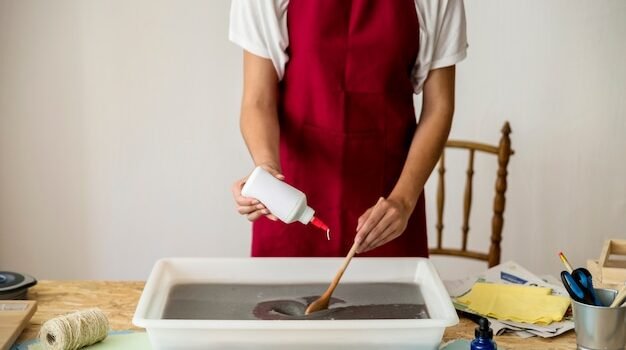
Correct solution preparation is essential for obtaining reliable binder performance. PVA is normally added gradually to water while the liquid is being stirred. Depending on the grade, the water may need to be heated to complete dissolution. Adding the powder too quickly can create lumps that are difficult to remove.
The manufacturer’s recommended temperature should always be followed because partially and fully hydrolysed grades may have different dissolution requirements. Excessive heating should also be avoided, as long exposure to high temperatures may affect the solution or encourage water loss.
Once the solution becomes uniform, it can be added to the ceramic mixture. Controlled mixing helps distribute the binder evenly across the particle surfaces. Air bubbles should be minimised, particularly in casting processes, because trapped air may create pores or defects in the finished product.
The solution should also be protected from contamination during storage. Changes in concentration caused by evaporation can affect viscosity and binder dosage, so containers should remain properly covered.
Selecting the Right PVA Grade
Not every PVA grade is suitable for every ceramic system. Molecular weight is one of the main selection factors because it affects solution viscosity and film strength. Higher-molecular-weight grades generally produce more viscous solutions, while lower-molecular-weight grades may be easier to mix or spray.
The degree of hydrolysis can influence water solubility, adhesion, and temperature requirements. Ceramic manufacturers should also consider the required flexibility of the green body. A brittle binder film may not perform well in a component that experiences mechanical stress before firing.
Other selection factors include ceramic powder type, particle size, processing method, drying conditions, desired green density, storage requirements, and firing schedule. Technical testing is necessary because the same PVA grade can behave differently in two ceramic formulations.
Controlling Drying and Binder Burnout
Drying must be carefully managed when PVA is used in ceramics. If water is removed too quickly, uneven shrinkage may cause cracks, warping, or internal stress. Thick or complex components may require slower drying so moisture can escape evenly from the entire body.
Binder burnout is another critical stage. The PVA must decompose and leave the ceramic body before final densification occurs. If the heating rate is too fast, decomposition gases may become trapped inside the product. This can cause bloating, pores, cracks, discolouration, or other defects.
A controlled firing schedule should provide enough time for gases to escape safely. The appropriate heating rate depends on binder concentration, component thickness, ceramic composition, furnace atmosphere, and airflow. For sensitive or high-value products, thermal analysis can help determine a suitable burnout temperature range.
Potential Challenges and Solutions
Although PVA offers many benefits, it must be formulated carefully. Excessive binder can increase viscosity, reduce ceramic solids loading, and create greater shrinkage during burnout. Insufficient binder may fail to provide the required green strength.
Poor dissolution can leave polymer particles or gel-like lumps in the mixture. These may create inconsistent bonding or surface defects. Proper water temperature, controlled addition, and sufficient mixing time can prevent this issue.
Some formulations may also become too rigid after drying. In such cases, a compatible plasticiser may be used to improve flexibility. However, every added ingredient can affect drying and firing, so the complete formulation should be tested rather than evaluating the binder alone.
Improving Ceramic Production with PVA
PVA provides a useful balance of water solubility, bonding strength, film formation, and processing flexibility. As a water soluble binder for ceramics, it can improve green strength, reduce breakage, and support cleaner water-based production. Its performance can be adjusted by selecting an appropriate grade and controlling concentration, mixing, drying, and firing conditions.
Successful use depends on more than simply adding the polymer to a ceramic powder. Manufacturers must understand how PVA interacts with their materials and equipment. With proper formulation and process control, PVA can contribute to efficient production, consistent component quality, and reliable performance across traditional and advanced ceramic applications.