


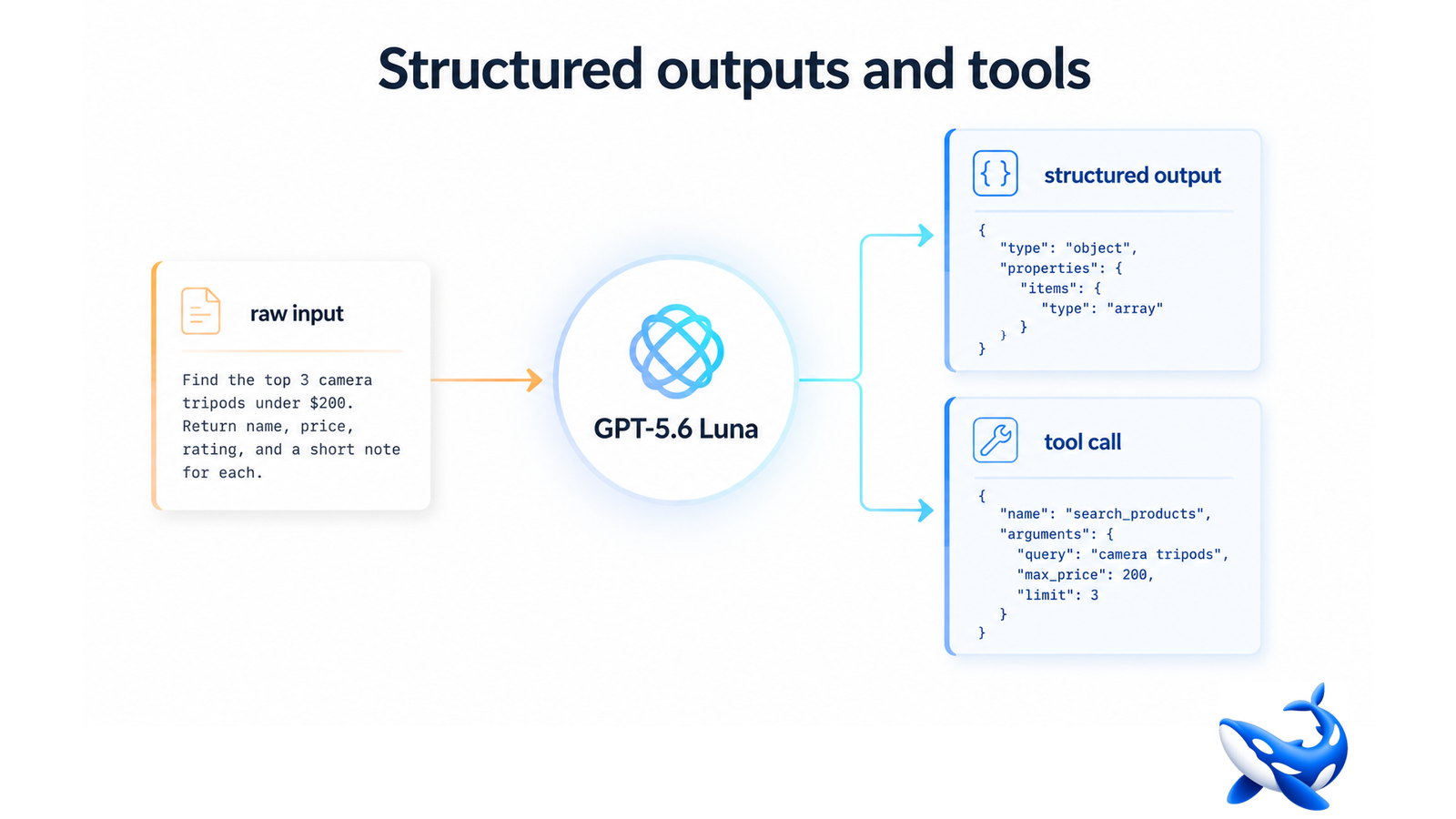
The GPT-5.6 Luna API model supports native tool calling and structured outputs, which are the two features that make a model dependable for pipelines. Combined with its price and reliability, they make Luna a strong choice for the systems that turn raw input into structured data. The GPT-5.6 family pricing breakdown covers the same model in the family context.
The difference between a demo and a pipeline is structure. A demo shows the model can answer; a pipeline needs the model to return data in a shape the code can consume, every time, without parsing prose or crossing fingers. Structured outputs and tool calling are the two mechanisms that provide that dependability.
Structured outputs: the answer comes back in a shape
Structured outputs let you specify the schema of the response, and the model returns valid data in that shape. For classification, that is a category and a confidence; for extraction, that is the fields with their values; for any downstream logic, it is data the code can consume directly. The value is that the pipeline does not have to parse prose, does not have to hope the model followed the format, and does not have to handle schema drift. The model page lists response format and structured outputs among the supported parameters, which means the dependability is native rather than bolted on.
Tool calling: the model can act
Tool calling lets the model invoke a function with the right arguments, which is what turns a model from a text generator into a component that can act. For agents, it is how a step calls an API, queries a database, or takes an action. For automation, it is how a request triggers a workflow. Luna supports native tool calling, and its 80.9 on terminal-bench 2.1 suggests the tool use is genuinely functional for lightweight agentic work. For the tasks Luna is built for — routing, lightweight agents, automation — tool calling is the mechanism that makes the model useful rather than merely responsive.
Reliability as the dependability multiplier
Structured outputs and tool calling are only dependable if the call succeeds, and Luna’s 0.05 percent error rate is what makes them dependable in production. A pipeline that extracts from a million items can rely on the vast majority of calls returning valid structured data on the first try, with a simple retry absorbing the rare failure. The combination — native structure plus a very low error rate — is what separates a dependable pipeline model from a capable one that needs babysitting.
Designing the integration
The integration pattern is standard: define the schema or tool set, send the input, get structured data or a tool call back, and validate downstream. The failure mode of structured output is not format — it is the model filling a field wrong when the input is ambiguous, so keep validation in the pipeline and let failures feed the prompt. For tool calling, verify the arguments match what your functions expect before executing them, and handle the “model wanted to call a function with odd arguments” case explicitly. These are the small disciplines that turn a capable model into a dependable pipeline component.
The cost of structure
Structured outputs and tool calls do not change the price — the model bills at $0.20 in and $1.20 out regardless. The structure is a capability, not a surcharge, which means the dependability comes at the same low price that makes high-volume pipelines affordable. That combination — native structure, low price, low error rate — is the reason Luna is the right model for the pipes that run on every item, forever.
Testing structured output before committing
Structured outputs are dependable in the shape, but the shape is not the whole story — the values matter, and the values are where testing is needed. Before committing a pipeline, test the schema on a representative sample of real inputs: the common cases, the edge cases, the inputs with missing or ambiguous fields. The goal is to find where the model fills a field wrong or returns an unexpected value, and to fix the prompt or the schema before the pipeline runs on everything. A schema that works on clean examples but breaks on the messy reality of your data is the classic failure. The testing is cheap — a few hundred requests at Luna’s price is almost nothing — and it is the difference between a dependable pipeline and one that looks dependable until the first ambiguous input. The model returns valid data; the validation ensures it returns correct data.
The takeaway
GPT-5.6 Luna’s native structured outputs and tool calling, at a 0.05 percent error rate and a $0.20/$1.20 price, make it a dependable pipeline model: classification and extraction return valid data in the shape you specify, and lightweight agents can act through tool calls. Validate downstream and verify tool arguments, and the structure is dependable at a price that makes running it at volume a rounding error.
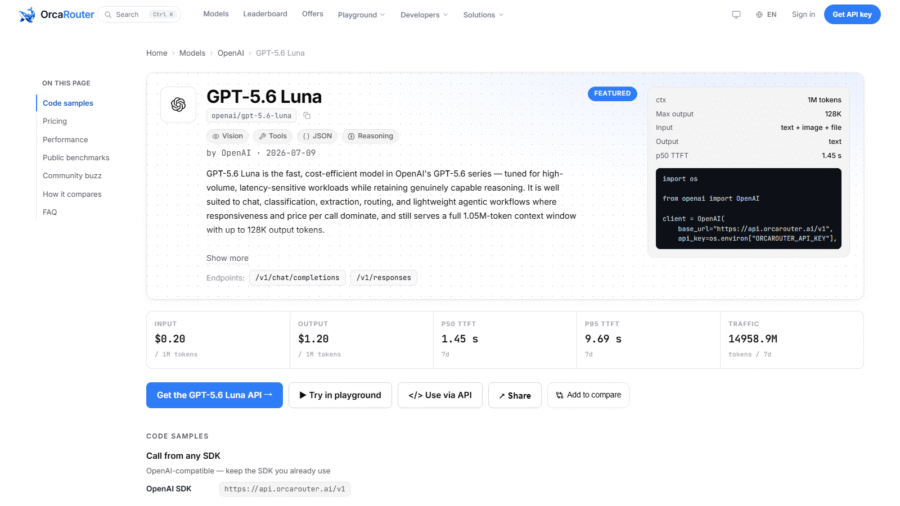
Sourcing note: Feature support, pricing, error rate, and terminal-bench score for GPT-5.6 Luna are from the OrcaRouter model page (checked August 2026); benchmark is sourced from artificialanalysis.ai.