The telecommunications landscape is shifting rapidly, and physical SIM cards are becoming a thing of the past. As the digital world evolves, eSIM technology has emerged as the gold standard for mobile connectivity. But what exactly makes this tiny chip so revolutionary? At its core, an esim (embedded SIM) is a digital version of the traditional SIM card that is built directly into your smartphone. For users looking to streamline their mobile experience, switching to this digital solution with Bakcell offers a seamless transition into the future of global communication.

By eliminating the need for a physical plastic card, users can activate their mobile plans instantly. This transition isn’t just about modernizing your device; it’s about embracing a more flexible, secure, and efficient way to stay connected wherever life takes you.

Top 5 Benefits of Using eSIM Technology at Bakcell

Transitioning to a digital esim provides several practical advantages that traditional cards simply cannot match. Here are the primary reasons why users are making the switch:

  • Instant Activation: Forget about visiting a store or waiting for a delivery. You can activate your profile via a simple QR code scan provided by Bakcell, getting you online in minutes.
  • Dual SIM Capability: Most modern smartphones allow you to use an eSIM alongside a physical SIM. This is perfect for those who want to keep their personal and work numbers on a single device without swapping cards.
  • Travel Convenience: If you are a frequent traveler, you can add international data plans digitally. This allows you to stay connected abroad while keeping your primary number active.
  • Space-Saving Design: For manufacturers, removing the SIM tray allows for larger batteries or better water resistance. For the user, it means a sleeker, more durable device.
  • Enhanced Security: Since the SIM is embedded in the phone, it cannot be removed if your device is lost or stolen, making it much harder for unauthorized users to compromise your number.

How to Get Started with Your Bakcell eSIM Today

Ready to upgrade your mobile experience? The process is designed to be as user-friendly as possible. To begin, you first need to ensure that your smartphone is compatible with digital SIM technology. Most flagship devices from recent years, including the latest iPhone, Samsung, and Google Pixel models, fully support this feature.

Once you have verified compatibility, you can obtain your unique activation code through the official Bakcell channels. Simply scan the provided QR code in your phone’s cellular settings, and your device will automatically configure the network parameters. There is no need for manual APN settings or physical handling. This digital-first approach ensures that your connection is optimized for high-speed 4G and 5G networks immediately upon activation, providing a stable and robust mobile experience for all your data and voice needs.

Returns Alone Can Feel Deceptive

Mutual fund performance often gets discussed using one simple number, such as a one year or three year return. Even though that number seems clear, it might not show what the benefits really are. Even if the returns on two funds are similar, one may have reached those levels through more slow growth and better risk management, while the other may have gone through sharp changes. A better picture is given by growth rate analysis, which looks at how regularly an investment has grown over time. When investors look past single market times, they can tell if a fund is really growing in value or just making money during a short market period. 

Growth Rate Analysis in Plain Terms

Growth rate analysis is essentially about measuring how an investment grows over time in a consistent framework. In mutual funds, that framework becomes more useful because portfolios hold multiple assets and may deliver returns differently across market cycles. Investors often care about both the speed of growth and the consistency of that growth. Some periods can feel great, then later returns can reverse. By looking at growth rates across the investment horizon, an investor can judge how the fund has behaved under different conditions, rather than reacting to a single snapshot.

Why CAGR Matters and What It Reveals

CAGR, or compound annual growth rate, turns messy multi year returns into a comparable annual figure. Instead of listing a total return over a period, CAGR estimates the steady rate that would grow the initial investment to the final value if growth happened smoothly each year. This matters because mutual funds do not always move in a straight line. A CAGR helps investors compare performance across different time frames and different funds, as long as the start and end dates are aligned. It also supports more disciplined decision making when someone evaluates options for long term goals.

Using a cagr calculator for Like for Like Comparisons

A cagr calculator is helpful because it removes guesswork. When an investor types in numbers, like the original investment amount and the current value after a certain amount of time, the tool figures out the annualised growth rate. It is easier to compare funds this way because overall return numbers for different time periods don’t get in the way. 

Growth rate analysis becomes much more meaningful when the same time horizon is used for each option and when investors clearly separate raw returns from fees. Even a strong CAGR can mislead if costs are high or if the fund took excessive risk to achieve it.

Don’t Stop at CAGR: Risk and Path Still Count

When you see CAGR as a starting place instead of a final answer, you start to think critically. Investors should look at the fund’s success during times when markets are down, as well as its drawdowns and instability. If an investor has a fund with a good CAGR but a lot of sharp drops, they may have to test their patience or take money out early. 

 Expense ratios also deserve attention, because they quietly reduce net returns over years. If the fund is concentrated in a few themes, returns might look strong during favourable cycles and weaker when sentiment changes.

Example Lens: axis mutual fund and the Same Evaluation Standard

When evaluating an axis mutual fund, the same growth rate reasoning should apply, regardless of brand reputation. Investors should not assume that a well known name automatically produces superior compounding. They can also look at CAGR along with other factors like stability, risk-adjusted returns, and whether the fund’s strategy fits with the investor’s time frame. Credibility is raised if the fund’s growth rate stays strong during different market stages. If the CAGR only rises in one favourable setting, it may be due to market timing or temporary tailwinds. 

The Practical Takeaway

Growth rate analysis helps investors move from “What happened last quarter?” to “How has this investment compounded over time?” CAGR offers an annualized view that supports fair comparison, while additional risk checks prevent overconfidence. Investors can assess mutual fund performance more clearly and make fewer rash decisions when they combine strict criteria with reasonable hopes.

You made the switch to an electric vehicle. The monthly fuel savings versus petrol are real, the running costs are lower, and you have largely stopped thinking about petrol prices.

But here is something most EV owners in India eventually notice: the electricity bill has quietly gone up. Not dramatically, but consistently. Every month, the car that was supposed to save you money is drawing from the same grid your home depends on — and in cities like Bangalore, where BESCOM tariffs run between ₹5.75 and ₹7.20 per unit depending on your consumption slab, that adds up faster than expected.

Rooftop solar does not just fix this problem. It fixes it permanently.

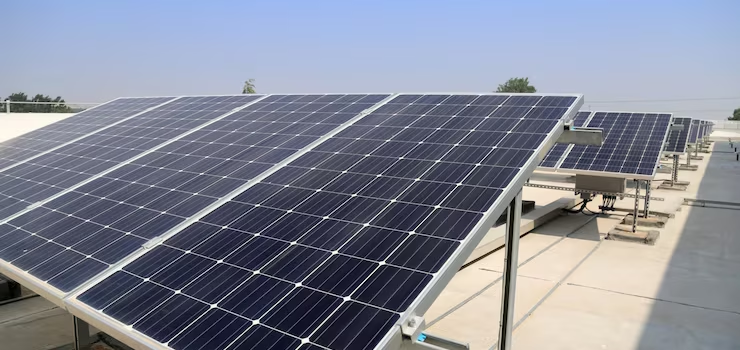
This is the case for why solar is the most logical next investment for any EV owner who lives in an independent house or villa — and why the two together create a financial and energy outcome that neither can achieve alone.

The EV Charging Cost Reality Check

Before making the case for solar, it helps to understand exactly what EV charging is currently costing you on the grid.

The Cost-Per-Km Breakdown

Charging an EV at home in India costs roughly ₹1 to ₹1.5 per kilometre — about six to seven times less than running a petrol car. That comparison is correct and important. But the relevant question for an EV owner who already made the switch is not “am I saving versus petrol” — it is “am I paying more than I need to?”

The answer, if you are charging on grid power, is yes.

Here is what the numbers look like in practice:

The Tata Nexon EV consumes roughly 180–200 Wh per kilometre in city conditions. Bengaluru (BESCOM) residents on a 200-unit monthly slab pay around ₹5.75–₹7.20 per unit.

Working through the math for a typical Bangalore EV owner driving 40 km per day:

Daily consumption for EV: approximately 8 units (at 200 Wh/km)

Monthly EV charging consumption: approximately 240 units

Monthly charging cost at ₹7/unit: approximately ₹1,680

Annual EV charging cost on grid: approximately ₹20,160

That is a meaningful recurring cost — and one that increases every time your DISCOM revises its tariffs upward, which has happened consistently across every major state in India over the past decade.

Now consider the same numbers with rooftop solar in the picture.

With solar, the effective cost of EV charging drops from ₹1–₹1.5 per kilometre to ₹0.50 or effectively ₹0 per kilometre. When you install a solar EV charging station at home, you are essentially pre-paying for 25 years of fuel.

How Solar EV Charging Actually Works: The Net Metering Explanation

The most common question EV owners ask about solar is a practical one: my car is not home during the day when solar is generating. How does daytime solar power help me charge at night?

The answer is net metering — and it is the mechanism that makes the solar-plus-EV combination work cleanly without batteries.

How Net Metering Works for EV Owners

During the daytime, your solar panels generate electricity. Since your car is not home, this power is exported to the grid. The electricity board — your DISCOM — banks these units for you. At nighttime, when you plug in your EV, you draw power from the grid, but the billing meter subtracts the units you banked during the day. This on-grid system is the most cost-effective setup.

In practical terms:

Your solar system generates 15–20 units during the day while you are at work

Those units are credited to your account by BESCOM or your local DISCOM

When you plug in your car at night, you draw from the grid — but against your banked solar credits

Your net bill reflects only what you consumed beyond what you generated

The result: your EV charges on solar energy — even though the physical electricity flowing into your car at 10pm came from the grid. The accounting makes it equivalent.

The Combined Savings: What Solar Does to Your Total Monthly Bill

For an EV owner in an independent house, the electricity bill typically has two components after buying a car: household consumption (lighting, fans, AC, appliances) and EV charging. Solar addresses both simultaneously.

Here is a worked example for a typical villa owner in Bangalore:

CategoryBefore SolarAfter Solar (5 kW system)Monthly household consumption400 unitsOffset by solar generationMonthly EV charging consumption240 unitsOffset via net metering creditsTotal monthly draw from grid640 unitsMinimal — only excess beyond generationEstimated monthly electricity bill₹4,500 – ₹6,000₹200 – ₹800 (fixed charges + minimal units)Annual electricity cost₹54,000 – ₹72,000₹2,400 – ₹9,600

The savings are not marginal — they are structural. A well-sized solar system for an EV-owning villa household essentially eliminates the electricity bill as a monthly expense.

What System Size Does an EV Owner Actually Need?

This is where most EV owners get it wrong: they think about solar only in terms of the car. The smarter approach is to think about solar for the whole house — and size up slightly to account for the car.

The expert recommendation is not to install solar just for the car. Install a system that covers your home’s AC, lights, and fans plus the car. A 3 kW to 5 kW system is the sweet spot for most Indian households to achieve a near-zero electricity bill.

Here is a practical sizing guide for EV-owning villa households:

Monthly Electricity Bill (Including EV Charging)Recommended System SizeDaily Generation₹3,000 – ₹5,0003 kW – 4 kW12–18 units₹5,000 – ₹8,0005 kW – 6 kW20–26 units₹8,000 – ₹12,0006 kW – 8 kW26–34 unitsAbove ₹12,0008 kW – 10 kW34–45 units

For an EV owner driving 40 km per day and running a moderately sized 3 BHK villa with one or two air conditioners, a 5 kW system is typically the right fit. It generates enough to cover both home loads and EV charging across most months of the year, with net metering handling the day-night mismatch.

The Payback Period When You Add an EV Into the Equation

Rooftop solar payback calculations for regular households typically show a 4–5 year return. For EV owners, the payback is often faster — because your total annual electricity savings are higher.

If you drive 40 km per day, you save roughly ₹60,000 per year in fuel and electricity costs combined when solar covers both your home and EV charging. The payback period works out to approximately 3.5 years — after which you enjoy 20 or more years of effectively free driving.

Let us build this out more conservatively for a Bangalore context:

Net system cost after ₹78,000 PM Surya Ghar subsidy (5 kW on-grid): approximately ₹2.00 lakh

Annual savings on household electricity bill: approximately ₹40,000

Annual savings on EV charging (previously ₹20,000/year on grid): approximately ₹18,000

Total annual savings: approximately ₹58,000

Estimated payback period: approximately 3.5 years

After that payback period, you have 20+ years of both home electricity and EV fuel at effectively zero cost. No fuel price hikes. No DISCOM tariff revisions that affect you. A fixed infrastructure investment that pays dividends for decades.

One Practical Consideration: Sanctioned Load

Before finalising your solar system design as an EV owner, there is one technical detail worth understanding.

If you install a 7.2 kW fast charger at home, your existing sanctioned load — usually 3–4 kW for most residential connections — may not be sufficient and could cause your main circuit to trip. You may need to apply to your electricity board to increase your sanctioned load, which carries a small deposit fee.

This is not a complex process, but it is something that should be addressed proactively rather than after installation. A good solar installer who works with EV-owning homeowners will factor this into the site assessment and system design, and guide you through the sanctioned load upgrade process if needed as part of the DISCOM coordination.

Shadow Analysis: Why It Matters More for EV Owners

Because an EV owner needs more total generation from the system than a non-EV household, shade losses hurt you more. Even a small shadow from a neighbour’s water tank can drop solar generation by 30%. A proper installer should conduct a shadow analysis and may recommend half-cut Mono PERC or TOPCon panels, which handle partial shading significantly better than standard panels.

When getting your system designed, specifically ask whether a shading analysis has been done and whether the panel technology chosen is optimised for your roof’s specific shadow profile. For EV owners where every unit matters, this is not a detail to overlook.

Solar + EV: The Environmental Argument That Actually Has Numbers

Most EV owners switched partly for environmental reasons. The honest footnote to that decision is that grid electricity in India is still largely coal-based. Even when charged on India’s current grid, lifecycle emissions for EVs are 30 to 40 percent lower than petrol cars, according to a 2024 ICCT study. That is a genuine improvement — but it is not the full picture.

When you charge your EV with rooftop solar, the electricity powering your car is genuinely zero-emission at the point of generation. Your car is no longer running on coal-offset savings. It is running on direct sunlight converted at your own rooftop. The environmental case for the EV you already bought becomes complete.

Which Solar System Type Makes Sense for EV Owners?

For most EV owners in urban areas with a reliable grid, an on-grid system with net metering is the right choice. It is the lowest cost option, offers the fastest payback, and handles the day-night EV charging mismatch perfectly through the net metering credit mechanism.

A hybrid system with battery storage makes sense if your area experiences frequent power cuts — because a grid outage on an on-grid system means no solar generation and no EV charging, just like it means no home power. If you live in an area with intermittent supply, a hybrid system ensures both your home and your car are covered regardless of grid status.

For most villa owners in Bangalore and Hyderabad with dependable BESCOM or TSSPDCL supply, on-grid is the practical recommendation that delivers the best financial return.

What the Government Is Doing to Support Solar + EV Adoption

The policy environment in 2026 is actively supportive of both EV ownership and rooftop solar — and there are early signals of convergence.

EV and solar bundling — combined subsidies for EV charging alongside rooftop solar — is expected to grow as part of India’s evolving solar subsidy framework. The PM Surya Ghar subsidy of up to ₹78,000 for residential solar is already available and directly reduces the cost of the solar system that will charge your EV. Meanwhile, the MNRE has set aside significant funds under the National Solar Mission specifically for solar EV charging infrastructure.

For an EV owner who installs solar now, the timing is close to optimal: subsidy amounts are at peak, panel costs have come down significantly, and net metering policy is well-established across Karnataka and Telangana.

How Arkahub Approaches Solar for EV-Owning Households

Arkahub is a residential-only solar installer operating in Bangalore and Hyderabad, and a meaningful share of installations serve households with EVs. The system design process for EV-owning homeowners accounts for total consumption including the car, shadow analysis for maximum generation, sanctioned load requirements, and net metering configuration — so the system is optimised for how you actually use electricity, not just a generic household profile.

The entire process — site assessment, system design, DISCOM coordination, net metering application, installation, and subsidy documentation — is managed end to end. Most installations are completed and commissioned within 14 days.

Monthly panel health checks and cleaning are included for the first four years as part of the standard Arkahub service.

Get a free site assessment and EV-specific solar quote 

Frequently Asked Questions

Can I charge my EV directly from solar panels during the day?

Yes, if your EV is parked at home during the day, it can draw directly from your solar system. However, most EV owners charge overnight. In that case, your solar system exports power to the grid during the day and you draw it back at night via net metering — the financial outcome is the same as direct solar charging, and no battery is required.

What size solar system do I need to charge a Tata Nexon EV?

The Tata Nexon EV consumes approximately 180–200 Wh per kilometre. For a daily drive of 40 km, that is roughly 8 units of daily EV charging consumption. A 3 kW solar system generates 12–15 units per day — enough to cover both the EV and basic home loads. For a larger home with ACs and higher appliance use, a 5 kW system is the more practical choice to offset the full combined load.

Does rooftop solar increase my EV’s resale value argument?

Solar does not directly affect the EV’s resale value. However, owning a home with a rooftop solar system that effectively eliminates electricity and charging costs is an increasingly recognised asset — particularly as more buyers are EV owners themselves. The combination of a solar-equipped home and an EV-ready charging setup is a meaningful value proposition in the premium residential property market.

Do I need a special charger to charge my EV using solar power?

No special charger is required for an on-grid solar setup with net metering. Your existing home charger or the portable charger supplied with your EV works as normal — the net metering mechanism handles the accounting of solar credits against your nighttime charging consumption. For faster daytime charging directly from solar, a smart EV charger that can modulate charging speed based on available solar generation is a useful upgrade, but not a requirement.

Will my solar system be big enough to handle future EV additions?

If you plan to add a second EV in the future — or upgrade to a larger EV with a bigger battery — it is worth sizing your solar system with that in mind from the outset. Adding capacity to an existing solar system is possible but more expensive than sizing correctly at installation. A good installer will ask about your expected future usage and factor it into the initial system design.

Is rooftop solar worth it if I already have an EV with low running costs?

Yes. The question is not whether EV charging is cheap on the grid — it is whether it could be cheaper or effectively free. For a villa owner with sufficient rooftop space, solar converts a recurring monthly cost (electricity bill including EV charging) into a one-time capital investment that pays back in under four years and then generates free energy for the next 20+. That is a straightforward financial case regardless of how low your current per-km charging cost already is.

Last updated: March 2026. Cost-per-km and electricity tariff figures are based on prevailing 2026 market rates and DISCOM tariff schedules. Actual savings will vary based on driving pattern, system size, roof orientation, and local tariff structure. Consult an MNRE-empanelled installer for a site-specific assessment.

Contemporary jewellery designs are becoming much influenced by comfort, flexibility, and likes. Furniture that previously occupied a fixed position in the conventional environment diverse setups are now being redesigned to fit daily living. In this regard, the right choice of light weight mangalsutra becomes significant because it gives people a chance to uphold the importance of culture and adopt comfort and simplicity.

The decision of selecting such a work does not only consider the appearance. It must be addressed regarding the integration of the design in everyday life, the way that the design compliments other outfits, and whether it is comfortable all day long. A good design becomes a daily fashion and not something that is put on every now and then.

1. Focus on a Design That Feels Effortless

The first thing to put into consideration when choosing a light weight mangalsutra is that it must make an automatic fit in your day-to-day life. Overly complex designs can also be assumed to be constraining to normal usage whereas simple designs provide comfort and versatility. The product design is fine and balanced to make sure the product does not attract irrelevant attention. This ensures that it is easy to put on all the time without having to be weighed down by the same.

2. Consider Versatility Across Outfits

The ability to choose jewellery that can be fitted to various clothing styles can be a way of simplifying how to dress on a daily basis. It is discovered that when people realize how light weight mangalsutra is able to match traditional and modern attire, it permeates their daily wardrobe after this discovery. The fact that it fades into different appearances gives it a sort of presence. Such inclusivity means that the composition will be applicable in various events.

3. Pay Attention to Length and Fit

Chain length is also important in the placement of the jewellery on the neckline. The wearing is more comfortable with a light weight mangalsutra which does not move too much. Shorter ones have a structured and elegant look whereas a little longer style has a flowy and loose look. Selection of the correct fit contributes to the level of comfort as well as the general style.

4. Choose Materials That Support Daily Use

Jewellery would last long, which is a vital consideration. A light weight mangalsutra fabricated using the well crafted materials will guarantee that the mangalsutra will maintain the same status over time. And there are good finishes and safe environments that contribute to comfort and durability. This enables the item to be elegant despite frequent usage.

5. Look for Subtle Yet Meaningful Detailing

Jewellery details are important in outlining the nature of jewellery. A well-planned light weight mangalsutra can be having little elements that carry significant impact and hence make it more engaging. These minor details make sure that the piece is not entire and at the same time it is not too dimensional. The balance makes it suitable even in the daily To wear and still retain its importance.

6. Select a Style That Matches Your Routine

Everyday activities are different to different individuals and jewellery must be in concurrence with these trends. This is to say that a light weight mangalsutra, which is easily fit within your lifestyle, will automatically be part and parcel of your daily outlook. The need to work, or to go on a date, the appropriate design must make the change without a struggle. This will ensure that it is practical and stylish.

Making a Choice That Feels Natural

The choice of jewellery to be put on daily is all about finding clothing to be comfortable and true to self. Things that can be incorporated into our everyday existence are becoming long term favourites as opposed to being in one or two occasions.

The jewellery can accompany you in various events of the day, a fact of which a considerate decision can enable. A design that is natural to wear will be less about modern trends and more about having a personal sense of comfort and identification.

You load into a match. Your heart beats a little faster. Maybe you’ve been here before—winning some, losing many, wondering why others seem to level up so quickly. What do they know that you don’t? The truth is, improving in any slot97  isn’t just about grinding for hours. It’s about playing smart, staying aware, and learning a few hidden habits that most players overlook.

Let’s break those secrets down in a way that actually sticks.

Understand the Game Before You Try to Master It

Most players jump straight into action. They skip tutorials. They ignore small details. Then they get frustrated when things don’t go their way.

But here’s the thing—every successful player starts by understanding the basics deeply.

Ask yourself: do you really know how the mechanics work? Not just the controls, but the timing, the patterns, the subtle advantages?

For example, think about a player who studies weapon recoil or character movement speed. While others spray randomly, they control every move with purpose. That small difference? It changes everything.

Take a step back. Watch how experienced players move. Notice their decisions. Learning is your first upgrade.

Practice With Purpose, Not Just Time

We’ve all heard it—practice makes perfect. But that’s not entirely true. Mindless repetition won’t make you better. Focused practice will.

Instead of playing ten random matches, try this: set one goal per session. Maybe today you focus on positioning. Tomorrow, your aim. The next day, your decision-making.

Sounds simple, right? But it works.

A friend of mine used to lose constantly. Then he started reviewing his matches. He noticed he always rushed into fights without cover. Once he fixed that single habit, his win rate improved almost overnight.

So next time you log in, don’t just play. Train with intention.

Stay Calm Under Pressure

Ever notice how mistakes happen when things get intense? Your hands sweat. You panic. Suddenly, you forget everything you practiced.

That’s where emotional control becomes your secret weapon.

Top players don’t just rely on skill. They rely on composure. They slow things down in their mind, even when the game speeds up.

Try this: when things get chaotic, take a breath. Literally. Reset your focus. Instead of reacting instantly, think for a split second.

It sounds small, but that pause can save you from costly mistakes.

Learn From Every Loss

Losing feels bad. No one enjoys it. But what if your losses were actually your biggest advantage?

Instead of blaming teammates or bad luck, ask yourself: what could I have done differently?

Was your positioning off? Did you misjudge the timing? Did you rush when you should have waited?

Every defeat carries a lesson. The faster you accept that, the faster you grow.

Think about athletes. They review their failures more than their wins. Why? Because improvement lives in those uncomfortable moments.

Use Smart Positioning to Win More Fights

You don’t always need better aim to win. Sometimes, you just need a better spot.

Positioning is one of the most underrated skills in any online game. Yet, it’s often the difference between winning and losing.

Imagine two players with equal skill. One stands in the open. The other uses cover, high ground, and angles. Who do you think wins?

Exactly.

Before engaging, ask yourself: “Am I in the best position right now?” If not, move. Even a small shift can give you a huge advantage.

Build Consistent Habits

Improvement doesn’t come from one big change. It comes from small, repeated actions.

Do you warm up before playing? Do you adjust your settings regularly? Do you review your performance?

Consistency builds confidence. And confidence improves performance.

For example, setting a daily routine—even 20 minutes of focused play—can sharpen your reflexes over time. It’s not about playing longer. It’s about playing smarter, again and again.

Watch, Learn, and Adapt

Have you ever watched skilled players and thought, “I could never do that”? That mindset holds you back.

Instead, watch with curiosity. What are they doing differently? How do they react in tough situations?

You’ll start noticing patterns. Maybe they move less but think more. Maybe they take fewer risks but win more fights.

Now here’s the key—don’t just copy them blindly. Adapt what works for you.

Your playstyle is unique. The goal is to refine it, not replace it.

Communication Changes Everything

If your game involves teamwork, communication is often the missing link.

Clear, simple calls can turn chaos into coordination. Instead of random movements, your team starts acting as one unit.

Even small phrases like “enemy left” or “wait before pushing” can make a huge difference.

And here’s a question—how often do you actually communicate effectively?

Improving this one skill can instantly boost your overall performance.

Final Thoughts

Getting better at any online game isn’t about talent alone. It’s about awareness, discipline, and small changes that add up over time.

You don’t need to be perfect. You just need to improve a little each day.

So next time you play, try one new approach. Focus on one habit. Learn from one mistake.

And see what happens.

Because sometimes, the biggest improvements come from the smallest shifts.